If you’re a cannabis grower, you may be wondering what a VPD chart is or how to use one. Knowing how to track vapor pressure deficit (VPD) is a valuable skill for many cultivators because it provides them with useful information about the state of their plants and their growing environment.
To understand why, we should first define what this term means. VPD measures the difference between the water vapor pressure at saturation (100% relative humidity) and the actual water vapor pressure in the air at a given temperature. (Zhong et al., 2023) It is usually expressed in kilopascals (kPa), a unit of pressure, and provides an indication of how quickly a plant may lose water through its leaves.
In a cannabis plant, nutrients are absorbed by the roots before traveling up through the vascular system. The water then evaporates inside the leaves and escapes through tiny pores called stomata (Allen et al., 1998). This process is called transpiration.
But how does VPD factor in? When VPD is too high, plants can lose water faster than their roots can replace it, leading to symptoms such as brown leaf tips. When VPD is too low, water moves through the plant more slowly, reducing its ability to deliver dissolved nutrients. Once a grower knows where things stand, they can adjust temperature and humidity to produce a more optimal VPD, and in turn, create a healthier growing environment for their plants.
In this guide, you’ll find a VPD chart that covers each stage of the cannabis lifecycle, including the seedling, vegetative, and flowering phases. You’ll also learn how to fine-tune your environmental conditions, and in turn, optimize your growing space.
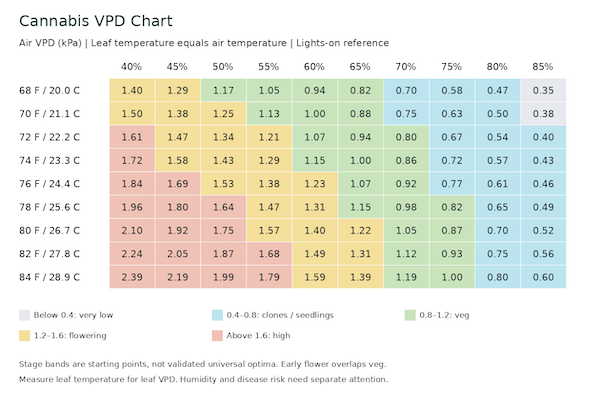
Cannabis VPD Chart
This VPD chart gives you practical starting ranges for each phase of the growing process.
What Is VPD and How Is It Calculated?
VPD stands for vapor pressure deficit. This measurement is calculated by subtracting the actual water vapour pressure in the air, or leaves, from the saturation water vapour pressure at the same air temperature (Grossiord et al., 2020).
To give a concrete example of how temperature and relative humidity (RH) factor in, imagine your grow tent has a temperature of 77 degrees Fahrenheit. At 70% RH, the vapor pressure deficit (VPD) is roughly 0.95 kPa. At 60% RH, air VPD is approximately 0.94 kPa at 68 degrees Fahrenheit—but 1.49 kPa at 82 degrees Fahrenheit. The humidity reading is identical, but the warmer environment creates greater evaporative demand. In other words, temperature and humidity work together to shape your growing environment (Allen et al., 1998).
While VPD describes the air’s drying power, a plant’s actual water loss also depends on a plant’s stomata— or tiny pores on the leaves through which water vapor escapes. Although higher VPD encourages faster water loss, a cannabis plant can partially close those pores to slow the process down. For this reason, VPD alone cannot tell you how much water actually leaves the plant (Grossiord et al., 2020).
Air VPD vs Leaf VPD
When growers talk about VPD, they may be referring to air VPD or leaf VPD. The difference between the two depends on whether VPD was calculated using air temperature alone or with leaf temperature factored in.
A grower may want to include leaf temperature because a cannabis plant’s leaves can be warmer or cooler than the surrounding air. Accounting for leaf temperature gives you a more plant-specific estimate of evaporative demand (Koverda, 2020).
Air VPD is simpler to track, as standard grow-room sensors typically measure air temperature and relative humidity. To calculate leaf VPD, measure leaf temperature with an infrared thermometer and enter it alongside your air temperature and relative humidity readings in a leaf VPD calculator (Koverda, 2020).
Cannabis VPD Chart by Growth Stage
Published growing guides don’t always agree on one exact range for every stage. The following table combines that guidance into practical starting bands, not experimentally established optima for every cannabis cultivar.
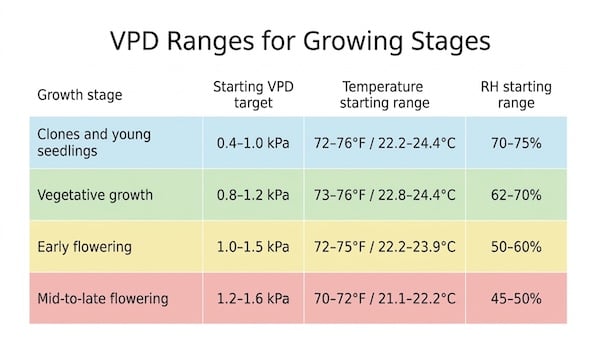
Note: These are general recommended ranges, not exact requirements, as every growing setup and cultivar will differ. As a good rule of thumb, aim to keep nighttime VPD fairly consistent with daytime levels. Temperatures typically fall after lights-off, causing relative humidity to rise, so some growers use a dehumidifier at night to lower relative humidity and keep VPD consistent.
VPD for Seedlings
Seedlings have small, delicate root systems that are still developing. Higher humidity helps reduce the amount of water they lose through their leaves while their roots establish. Keep VPD toward the gentler end of the chart during this early stage, then adjust as your plants grow and their roots develop. Exact recommendations will vary, but .4-1.0 kPA is a good starting range.
Note: A humidity dome creates a separate microclimate. If you’ve decided to use one, just make sure to measure beneath the dome itself instead of relying upon the tent’s main sensor. If you’d like to learn more about this approach in general, our guide Humidity Domes for Seedlings offers setup and ventilation advice.
VPD for Veg
Once your plants enter the vegetative stage, aim for a VPD of around 0.8–1.2 kPa. You can start near the lower end of this range and gradually move toward the middle as the roots and foliage develop (Koverda, 2020).
Although a higher VPD increases the air’s demand for water from the leaves, it doesn’t automatically lead to faster growth. If VPD gets too high, the plant’s stomata (tiny pores on the leaves) can narrow to limit water loss. This also restricts how much carbon dioxide the plant can take in for photosynthesis (Grossiord et al., 2020). For healthy growth, balance VPD with consistent watering and appropriate lighting rather than treating VPD as a growth accelerator on its own.
Image credit: Esteban López
The Best VPD Levels for Flowering
During the flowering stage, aim for a VPD of 1.0–1.5 kPa in the early stages, gradually moving towards 1.2–1.6 kPa as the flowers develop. Your unique setup may require different exact figures, but these ranges can provide a good jumping-off point.
As buds become denser, pay closer attention to humidity and airflow within the canopy. Even when VPD readings are within the recommended range, pockets of trapped moisture and overnight condensation can still occur, creating conditions that favour disease (Bartok, 2026).
If conditions call for lower relative humidity, reduce it gradually rather than making a sudden change just because harvest is approaching.
A Note on VPD for Autoflowers:
If you’re cultivating an auto strain, recommended VPD will typically remain the same for each growing stage. As with any cannabis plant, it’s good to use these ranges as guidelines, not inflexible rules. Just remember that with an auto strain, your timeline will be compressed. If you’re looking to cultivate an auto strain for the first time, o
How to Calculate VPD
One of the simplest ways to calculate VPD is to use a VPD calculator, like this one by Innovo Dev. You’ll also find the steps listed below if you’d like to try it on your own. To determine VPD, you’ll need a temperature and humidity sensor, plus an infrared thermometer. When setting up your growing space, position your temperature and humidity sensor level with the canopy, ensuring it isn’t near a humidifier or in the path of any direct mist. When measuring leaf temperature, be sure to sample multiple leaves instead of relying upon just one.
Let’s calculate VPD for the following scenario: Your grow tent has an air temperature of 77°F (25°C), relative humidity of 60%, and a leaf temperature of 73.4°F (23°C).
Step 1: Calculate saturation vapor pressure
You can look up saturation vapor pressure in a table or calculate it from temperature using the Tetens equation below (Allen et al., 1998, Equation 11). Before starting, convert your temperatures to Celsius.
SVP(T) = 0.6108 × e^[(17.27 × T) / (T + 237.3)]
The result is your saturation vapor pressure, in kilopascals (kPa).
For our specific example, the equation would look like:
SVP(25) = 0.6108 × e^[(17.27 × 25) / (25 + 237.3)] ≈ 3.168 kPa
Note: Here, T is temperature in degrees Celsius, and e is a fixed mathematical constant, approximately 2.71828.
Step 2: Calculate Air VPD
Plug the saturation vapor pressure (SVP) from Step 1 and the growing room’s relative humidity (as a percentage) into the equation below.
Air VPD = SVP(air temperature) × (1 − RH/100)
For our tent, the SVP at 77°F (25°C) is approximately 3.168 kPa, and relative humidity is 60%, so the formula becomes:
Air VPD = 3.168 × (1 − 60/100) ≈ 1.27 kPa
Step 3: Calculate Leaf VPD
Your leaves may be warmer or cooler than the surrounding air. To account for this, use the equation from Step 1 to calculate SVP, but this time, use the leaf temperature, not the air temperature. Then subtract the actual vapor pressure of the surrounding air.
Leaf VPD = SVP(leaf temperature) − [SVP(air temperature) × RH/100]
For our tent’s leaves at 73.4°F (23°C), the SVP is approximately 2.809 kPa:
Leaf VPD = 2.809 − (3.168 × 0.60) ≈ 0.91 kPa
Here, the cooler leaves give an estimated leaf VPD of 0.91 kPa, compared with the air VPD of 1.27 kPa that we calculated earlier.
Note: This estimate assumes the air spaces inside the leaf are saturated.
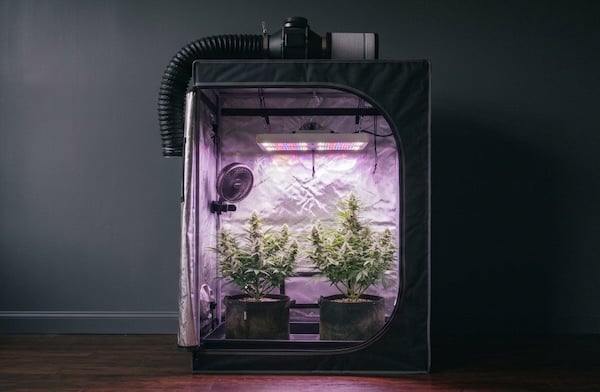
What is VPD in a Grow Tent?
If your VPD is too high or too low, you can adjust the temperature and/or humidity in your grow space to bring it closer to the recommended range. For example, you might:
- Add a humidifier if the air is too dry.
- Lower the temperature if your grow tent is too warm.
- Adjust exhaust ventilation if it’s continually pulling in drier air from the surrounding room.
- Adjust light intensity or fixture height if your lights are heating the leaves too much.
Addressing these issues as directly as possible is the best approach. Meanwhile, shortcuts can introduce new challenges, potentially creating more work in the long run. For example, if you want to adjust relative humidity (RH), use a humidifier or dehumidifier. While an adjustment in light can increase RH, it also introduces the added challenge of reduced energy for your plants.
You can learn more in our guide: How to Adjust Relative Humidity in a Grow Tent.
How to Raise and Lower VPD in a Grow Tent
Because VPD depends on both temperature and relative humidity (RH), it’s important to consider how they work together when making adjustments. Raising temperature or lowering RH will change VPD, but doing so may create other problems for your plants. For example, you could raise the temperature enough to reach your target VPD, but risk overheating your plants.
The best approach is to make adjustments gradually, keeping temperature and RH within a healthy range rather than chasing a VPD target at the expense of either.
In practice, this can look like:
- Raising the temperature or running a dehumidifier to raise VPD.
- Lowering the temperature or running a humidifier to lower VPD.
- Adjusting the exhaust fan to exchange tent air with cooler or drier air from outside the tent, when available.
- Improving airflow through dense areas of the canopy to reduce pockets of humid air around the leaves.
Plan for Relative Humidity Changes at Night
When your grow lights are off at night, the lower room temperature can cause relative humidity to rise. When leaves cool below their dew point, condensation develops and could potentially lead to issues such as mold or mildew. This situation can be avoided by monitoring the overnight environment and adjusting the temperature and humidity levels to remain consistent with your daytime environment.
Note: Wilting, curled leaves, slow growth, or damaged tips deserve investigation, but none of these issues necessarily point to VPD as the cause. When you notice something is off about your plants, the best approach is to consider your environmental conditions in addition to other variables such as watering schedules, root health, nutrition, and light exposure.
Image credit: Jonathan Cooper
Build a Better Environment One Adjustment at a Time
Start with reliable temperature and humidity measurements, check leaf temperature when possible, and make gradual adjustments. A chart becomes useful when it helps you understand the tent—not when it distracts you from the plants.
Dial in your environment, then give it genetics that can use it. Explore beginner-friendly or mold-resistant seeds suited to your setup, remembering that resistance doesn’t replace good humidity control.
FAQs
What does VPD stand for?
VPD stands for vapor pressure deficit and measures the difference between the water vapor pressure at saturation and the actual water vapor pressure in the air at a given temperature. (Zhong et al., 2023)
What is the best VPD for flowering?
Approximately 1.0–1.5 kPa is a practical early-flower starting range, moving toward 1.2–1.6 kPa later if plants respond well. Recommended ranges will ultimately vary, so the best approach is to monitor your plants and adjust VPD accordingly.
Should I use leaf temperature or air temperature?
Air temperature is useful for tracking VPD, but factoring in leaf temperature gives you a better estimate of how readily your leaves can lose water. If possible, measure leaf temperature rather than assuming your leaves are warmer or cooler based on the type of grow light you use (Koverda, 2020).
Is VPD important for autoflowers?
Yes. Temperature and humidity affect water loss in autoflowers, too. Base your adjustments on the plant’s actual stage of growth rather than its age in weeks.
Can VPD be too low?
Yes. When VPD is very low, plants experience less demand to release water through their leaves. Persistently high humidity or condensation can also create conditions that encourage disease. However, low VPD alone doesn’t mean your plants have mold or a nutrient deficiency (Wollaeger & Runkle, 2015).
Do I need a different VPD chart for autoflowers?
No. While no one chart can accurately predict the absolute best VPD for your unique situation, the recommended ranges typically don’t shift much if you’re growing an auto plant. That said, autos will usually have an accelerated growing time. For this reason, you may need to adjust the VPD for each stage within a shorter timeframe, but the recommendations themselves will remain the same.
References
Arvida Labs. (2025, August 19). How is THCv made: Production methods for B2B partners. https://www.arvidalabs.com/post/how-is-thcv-made
AskGrowers. (n.d.). Power Plant. https://askgrowers.com/strains/power-plant-strain-review
Benton, E., & Ritchey, C. (2025, March 26). Everything you need to know about THCV, the so-called “diet weed.” Men’s Health. https://www.menshealth.com/health/a39865342/what-is-thcv/
Citti, C., Linciano, P., Russo, F., Luongo, L., Iannotta, M., Maione, S., Laganà, A., Capriotti, A. L., Forni, F., Vandelli, M. A., Gigli, G., & Cannazza, G. (2019). A novel phytocannabinoid isolated from Cannabis sativa L. with an in vivo cannabimimetic activity higher than Δ⁹-tetrahydrocannabinol: Δ⁹-tetrahydrocannabiphorol. Scientific Reports, 9, Article 20335. https://doi.org/10.1038/s41598-019-56785-1
Congressional Research Service. (2026, September 28). Changes to the statutory definition of hemp and implications for agricultural policy (IF13136). https://www.congress.gov/crs-product/IF13136
ElSohly, M. A., Majumdar, C. G., Chandra, S., & Radwan, M. M. (2024). A 10-year trend in cannabis potency (2013–2022) in different geographical regions of the United States of America. Frontiers in Public Health, 12, Article 1442522. https://doi.org/10.3389/fpubh.2024.1442522
Englund, A., Atakan, Z., Kralj, A., Tunstall, N., Murray, R., & Morrison, P. (2016). The effect of five-day dosing with THCV on THC-induced cognitive, psychological and physiological effects in healthy male human volunteers: A placebo-controlled, double-blind, crossover pilot trial. Journal of Psychopharmacology, 30(2), 140–151. https://doi.org/10.1177/0269881115615104
Haghdoost, M., López de los Santos, Y., Brunstetter, M., Ferretti, M. L., Roberts, M., & Bonn-Miller, M. O. (2024). Using in silico molecular docking to explain differences in receptor binding behavior of HHC and THCV isomers: Revealing new binding modes. Pharmaceuticals, 17(5), Article 637. https://doi.org/10.3390/ph17050637
Jadoon, K. A., Ratcliffe, S. H., Barrett, D. A., Thomas, E. L., Stott, C., Bell, J. D., O’Sullivan, S. E., & Tan, G. D. (2016). Efficacy and safety of cannabidiol and tetrahydrocannabivarin on glycemic and lipid parameters in patients with type 2 diabetes: A randomized, double-blind, placebo-controlled, parallel group pilot study. Diabetes Care, 39(10), 1777–1786. https://doi.org/10.2337/dc16-0650
Kim, A. L., Yun, Y. J., Choi, H. W., Hong, C.-H., Shim, H. J., Lee, J. H., & Kim, Y.-C. (2022). Profiling cannabinoid contents and expression levels of corresponding biosynthetic genes in commercial cannabis (Cannabis sativa L.) cultivars. Plants, 11(22), Article 3088. https://doi.org/10.3390/plants11223088
Lab Effects. (2023, October 15). Durban Poison terpenes and profile. https://labeffects.com/blogs/news/durban-poison-terpenes-everything-you-need-to-know
Mendoza, S. (2025). The role of tetrahydrocannabivarin (THCV) in metabolic disorders: A promising cannabinoid for diabetes and weight management. AIMS Neuroscience, 12(1), 32–43. https://doi.org/10.3934/Neuroscience.2025003
Neuhofer, Z. T. (2026, September 28). Changes to the statutory definition of hemp and implications for agricultural policy (IF13136). Congressional Research Service. https://www.congress.gov/crs-product/IF13136
Olmos, R. (2024, November 19). Best THCV strains. NuggMD. https://www.nuggmd.com/blog/thcv-strains-and-weed-diet
People Science. (n.d.). Phylos case study. https://www.peoplescience.health/case-study-phylos-bioscience
Peters, E. N., MacNair, L., Harrison, A., Feldner, M. T., Eglit, G. M. L., Babalonis, S., Turcotte, C., & Bonn-Miller, M. O. (2023). A two-phase, dose-ranging, placebo-controlled study of the safety and preliminary test of acute effects of oral Δ⁸-tetrahydrocannabivarin in healthy participants. Cannabis and Cannabinoid Research, 8(S1), S71–S82.
https://doi.org/10.1089/can.2023.0038
Riedel, G., Fadda, P., McKillop-Smith, S., Pertwee, R. G., Platt, B., & Robinson, L. (2009). Synthetic and plant-derived cannabinoid receptor antagonists show hypophagic properties in fasted and non-fasted mice. British Journal of Pharmacology, 156(7), 1154–1166. https://doi.org/10.1111/j.1476-5381.2008.00107.x
Turovsky, E. H., Moriarty, K., Chavarria, N., Parco, J. E., Kachadourian, R., & Brasuel, M. G. (2026). Application of thermogravimetric analysis (TGA) and differential scanning calorimetry (DSC) to estimate the normal boiling points of ∆⁹-tetrahydrocannabivarin (THCV) and ∆⁹-tetrahydrocannabinol (THC). Journal of Cannabis Research, 8, Article 9. https://doi.org/10.1186/s42238-025-00373-w
Zamengo, L., Bettin, C., Badocco, D., Di Marco, V., Miolo, G., & Frison, G. (2019). The role of time and storage conditions on the composition of hashish and marijuana samples: A four-year study. Forensic Science International, 298, 131–137. https://doi.org/10.1016/j.forsciint.2019.02.058