So, you’re wondering how often to water your weed plants?
The short answer is to water them whenever the top inch of soil feels dry, which usually works out to be every 2-3 days. But sticking to a strict calendar is the fastest way to run into trouble. Learning to read your plants and their environment is the real key to success.
The Simple Answer to Watering Your Weed Plants
Alright, let’s get right to it. You’ve got your seeds, your setup is ready, and now you’re staring at your plants, wondering how often you should actually water them.
The honest answer is, “it depends.” But don’t worry, we’re going to break that down without the confusing jargon. This is your starting point for learning to “read” your plants and the soil they live in, which is what separates the pros from the novices.
Think of it this way: you don’t drink the exact same amount of water every single day, right? Some days you’re more active, others you’re just chilling. Your plants are the same. Their thirst changes based on their age, the size of their pot, and what’s going on in your grow space. Ditching the guesswork and paying attention to these factors will make you a much better grower.
Growth Stage Makes a Huge Difference
Your plant’s watering needs change a lot as it grows. A tiny seedling barely sips water, while a big, bushy flowering plant can be seriously thirsty. Understanding these stages is the first step to getting your watering right.
For first-time growers, having the right gear can make this process way easier. You can check out our guide on the simplest starter grow setup for first-time cultivators to get your environment dialed in.
- Seedling Stage: Tiny roots mean they can’t handle much water. Overwatering here is a classic rookie mistake that can stunt them for good.
- Vegetative Stage: As the plant grows bigger with more leaves, its water intake shoots up. This is when a consistent wet-dry cycle is super important for strong root development.
- Flowering Stage: Water needs are at their absolute peak as the plant focuses all its energy on producing buds. You’ll be watering more, but you also need to be careful not to create a humid environment that invites mold.
A plant’s life stage is the biggest indicator of its thirst. A seedling in a solo cup needs a totally different approach than a 5-foot plant in a 10-gallon pot that’s deep into its flowering cycle.
A Basic Watering Guideline
To give you a clearer picture, let’s look at how watering frequency evolves.
Just after sprouting, many growers water their seedlings up to twice a day with tiny amounts of water, maybe just 200 ml, to keep that small root zone from drying out. Once plants move into the vegetative stage in 3 to 5-gallon pots, most growers find a rhythm of watering every 2 to 3 days.
Then, in the last couple of weeks before harvest, it’s common to cut back on watering a bit. This helps lower the overall humidity in the grow space, which is a smart move to protect those precious buds.
Here’s a quick look at what a typical schedule might look like to get you started.
Quick Guide to Watering Frequency by Growth Stage
This table gives you a simple, at-a-glance reference for how often you should be thinking about watering your cannabis plants as they mature. Think of it as a starting point, not a strict rule.
| Growth Stage | Typical Frequency (Indoor) | Water Amount Goal |
|---|---|---|
| Seedling (Weeks 1-3) | Every 2-4 days | Keep soil lightly moist, not soaked |
| Vegetative (Weeks 3-8) | Every 2-3 days | Saturate soil until 10-20% runoff |
| Flowering (Weeks 8+) | Every 2-3 days | Saturate soil until 10-20% runoff |
Remember, the best growers always check their soil before grabbing the watering can. This chart will get you in the ballpark, but your plants will tell you the rest.
Mastering the Basics of Proper Watering
Before we start talking schedules and calendars, let’s get the fundamentals down. Getting this part right is everything. It’s less about following a rigid routine and more about developing an instinct for what your plants are telling you they need.
Think of it this way: just dumping water in a pot isn’t the whole story. The quality of your water and how you check for dryness are the two core skills that separate the rookies from the pros, whether you’re growing one plant or a whole tent full of our feminized cultivars.
Why Your Water Quality Matters
Most of us just turn on the tap, but that water isn’t always perfect for your plants. The single biggest thing to pay attention to is its pH level, a simple scale that measures how acidic or alkaline your water is.
For cannabis grown in soil, you’re aiming for a pH sweet spot between 6.0 and 7.0. If your water’s pH is off, your plant can’t absorb the nutrients available in the soil, even if they’re plentiful. This is called “nutrient lockout,” and it’s one of the most common headaches for new growers.
Your water’s pH level is a huge deal. Getting it right ensures your plants can actually ‘eat’ the food you’re giving them. If it’s off, your plants will starve no matter how much you feed them.
You can grab a simple pH testing kit online or from any garden store. If you find your tap water is outside that ideal range, you can easily tweak it with pH up or down solutions. It sounds technical, but it’s a five-second step that prevents a world of problems later on.
Old School Ways to Check Soil Moisture
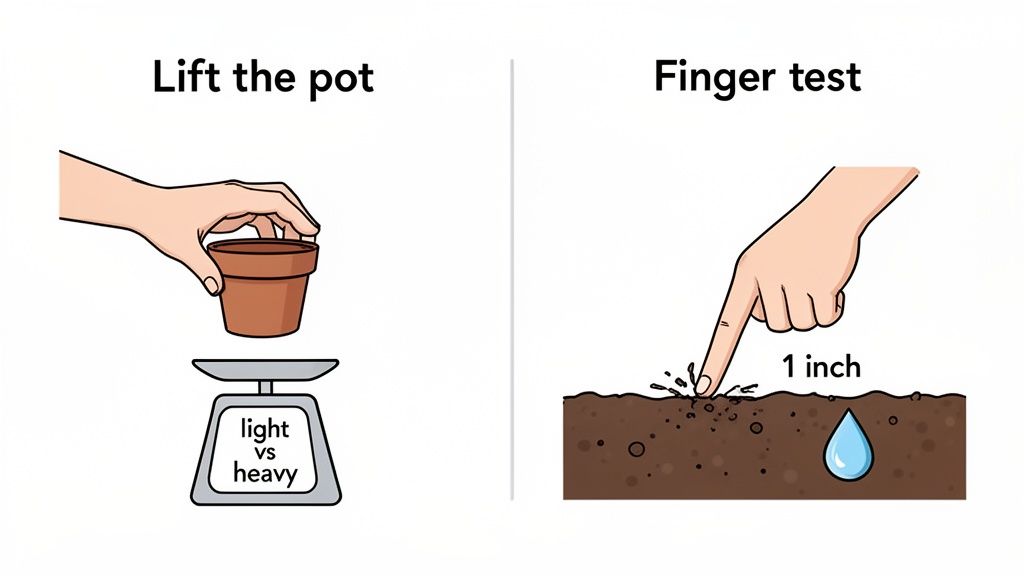
Forget the fancy gadgets for a minute. There are two classic, tool-free methods that every single grower should master. These tricks help you learn the feel of your plants and what they really need.
Learning how to water properly means getting your hands dirty, sometimes literally. These two techniques are your best friends.
1. The Finger Test
This one is exactly what it sounds like. Just stick your index finger into the soil up to about your first knuckle.
- If the soil feels dry at your fingertip, it’s go-time. The top layer is officially dry enough that the roots below will appreciate a fresh drink.
- If you feel any moisture, hold off. Give it another day. Watering again too soon is the fastest way to overwater your plants.
This simple check is foolproof and prevents one of the most common mistakes in the book: loving your plants to death with too much water.
2. The Pot Lift Method
This one is all about developing a feel for things and building a real intuition. Right after you’ve given a plant a thorough watering, pick up the pot and get a sense of its weight. It’s going to be heavy and fully saturated.
A day or two later, lift it again. You’ll immediately notice it’s significantly lighter. That difference in weight is your cue. Once the pot feels almost surprisingly light, you know the plant has used up most of the water and is ready for its next soak. After doing this a few times, you’ll be able to tell if it’s watering time just by giving the pot a little nudge.
How Your Pot Size and Medium Change Everything
Ever wonder why your buddy waters his plants every day, but yours seem fine for three? It’s not magic, it’s all about the setup. The container you choose and what you’re growing in (the medium) completely change the watering game. Nailing this part means you can stop guessing and start giving your plants exactly what they need.
Thinking about how often to water weed plants without considering the pot is a classic rookie mistake. The size and type of your container directly impact how quickly the medium dries, which pretty much dictates your entire schedule.
Pot Size and Type Matter A Lot
Let’s start with the obvious one: a small pot holds less medium, so it dries out way faster. A tiny seedling in a solo cup might need a little sip of water every day, while a beast of a plant in a 10-gallon pot could go for several days between drinks.
It’s not just about volume, though. The material of your pot plays a huge role.
- Plastic Pots: These are the standard for a reason. They don’t let air or water escape through the sides, so they hold onto moisture for a lot longer. This is great if you want to water less often, but you have to be extra careful not to overdo it.
- Fabric Pots (Smart Pots): We’re big fans of these. They allow air to get to the roots, which is awesome for plant health and prevents them from getting root-bound. The trade-off? They dry out much, much faster than plastic, especially from the sides. You’ll definitely be watering more frequently.
- Terra Cotta/Clay Pots: These are less common for cannabis but act a lot like fabric pots. They’re porous, so they breathe and dry out quickly.
The bottom line is simple: Bigger pots need less frequent but heavier watering. Smaller pots need more frequent, lighter watering. And fabric pots will always dry out faster than plastic ones of the same size.
Soil, Coco, or Hydro: The Big Three
Now for the really important part: what your plants are actually growing in. Each medium has a totally different relationship with water, and your choice will have the single biggest impact on your watering routine. You can learn more about the pros and cons of each in our guide on how to choose the right cannabis growing medium.
Growing in Soil
Soil is the most forgiving and traditional medium out there. It holds onto water and nutrients well, giving you a nice buffer if you forget to water for a day or accidentally give a little too much.
A good soil grow is all about mastering the wet-dry cycle. You want to give it a good soak until you see runoff, then let it dry out almost completely before watering again. For a plant in a 5-gallon fabric pot, this usually means watering every 2 to 3 days.
Growing in Coco Coir
Made from coconut husks, coco coir might look like soil, but it behaves very differently. It’s an inert medium, meaning it has zero nutrients on its own. You have to provide them with every watering in a process often called “fertigation.”
Coco holds a ton of oxygen, which roots absolutely love, but it doesn’t retain water quite like soil. This means you’ll be watering way more often, sometimes even daily, especially once your plants get big. It’s not uncommon for a plant in a 5-gallon pot of coco to need water every single day during peak flower.
Growing with Hydroponics
Hydroponics is a whole different world. In a hydro setup, there’s no soil or coco at all. The roots are either suspended directly in a nutrient-rich water solution or are sitting in an inert medium like rockwool or clay pebbles.
Because the roots have constant access to water, oxygen, and nutrients, the question of “how often” changes completely. You’re not watering in the traditional sense; you’re managing a system that provides water 24/7. Your job shifts to monitoring pH levels, nutrient strength, and water temperature to keep everything running smoothly.
A widely referenced rule from growers is to water at 5–10% of the container’s volume. That means a 5-gallon pot (about 19 liters) usually gets 1–2 liters of water each time. For most indoor soil grows, this works out to a schedule of every 2–3 days. However, in hotter rooms or with coco, daily feeding might be necessary.
Adapting to Your Environment and Cultivars

Your grow room isn’t just a room; it’s a tiny climate you’ve created. This environment has a massive impact on your watering schedule, and getting a handle on it is the key to mastering how often to water your cannabis plants. You have to pay close attention to what’s happening in your space.
A hot, dry room with a powerful fan is going to make your plants incredibly thirsty, almost like they just ran a marathon. On the other hand, plants in a cooler, more humid space will sip water slowly. It’s all about finding that balance.
Dialing in Your Grow Space Conditions
Think of your grow room’s temperature, humidity, and airflow as a connected system. When one element changes, it affects the others, and that directly influences how often your plants need a drink.
- Temperature: Hotter temps mean faster evaporation from the soil and more transpiration (the plant version of sweating) from the leaves. A plant sitting in an 85°F (29°C) room will drink far more than one chilling at 70°F (21°C).
- Humidity: When humidity is high, the air is already saturated with moisture, so your plants won’t “sweat” as much. Low humidity, a common side effect of strong air conditioning, will literally pull moisture from your plants and soil, causing them to dry out much faster.
- Airflow: A good breeze is great for strengthening stems and keeping mold at bay. But a fan blasting directly onto your plants will dry out both them and their soil in no time. The goal is gentle, indirect air circulation.
Getting these factors right is a total game-changer. You stop just following a schedule and start responding to the specific conditions you’ve built for your plants.
Not All Cultivars Are Created Equal
Just like people, different cannabis cultivars have their own unique quirks and needs. A big, bushy indica-dominant plant with huge fan leaves is going to have a much bigger appetite for water than a slender, lanky sativa.
The genetics packed into each seed dictate the plant’s structure, leaf size, and overall vigor, and all of these traits influence its thirst. A cultivar known for explosive growth will naturally need more fuel, and that fuel is water.
This is where the scale of your grow really comes into play. For instance, an average mature cannabis plant can demand around 22.7 liters (6 gallons) of water per day in hot, outdoor, high-yield conditions. In sharp contrast, a compact indoor plant in a 3–5 gallon pot might be perfectly happy with a deep watering every 2–3 days. You can learn more about how cannabis water needs vary with the grow setup on askgrowers.com.
Tips for Autoflower and Feminized Cultivars
Here at Pacific Seed Bank, we specialize in autoflowering and feminized seeds, and they each have slightly different watering needs. We don’t mess with regular seeds, so we’ve gotten really good at understanding what makes these two types thrive.
Watering Autoflowers
Autoflowers are on a strict timeline, racing from seed to harvest in as little as eight weeks. Because their lifespan is so compressed, they develop a smaller, less extensive root system compared to a photoperiod plant you could veg for months.
The number one rule with autoflowers is do not overwater them when they’re young. Stunting an auto in its first couple of weeks is a mistake it never really recovers from. Their short timeline just doesn’t give them a chance to bounce back.
We always recommend starting them in their final pot to avoid transplant stress. Be super careful with that watering can for the first two or three weeks, and let the medium dry out properly between waterings to encourage those roots to go searching for moisture.
Watering Feminized Photoperiod Cultivars
Feminized photoperiod plants offer a lot more control and flexibility. You get to decide how long they stay in the vegetative stage, which means you can grow some absolute monsters. A bigger plant obviously means a bigger root system and a much greater thirst.
The core principles are the same, always follow the wet-dry cycle. However, a large photoperiod plant deep into flowering, sitting under powerful lights, can easily drink a gallon of water or more every single day. The ‘lift the pot’ method becomes your best friend here, as its water consumption can change dramatically from one week to the next. It’s all about adapting to what that specific plant needs at that specific moment.
Spotting Overwatering and Underwatering Issues
Let’s be real, we’ve all been there. You either love your plants a little too much or get busy and forget about them for a day. Learning to spot the signs of watering stress is a core skill for any grower, and it’s easier than you think once you know what to look for.
The tricky part is that to a new grower, the symptoms for too much and too little water can look surprisingly similar at first glance. Both can make your plant look sad and droopy, but the way it droops is the key difference.
Signs of an Overwatered Plant
Overwatering is probably the single most common mistake new growers make. It happens when you’re just trying to show your plants some love, but you end up suffocating their roots. When roots sit in soggy soil, they can’t get any oxygen, which is just as vital as water for their survival.
Here’s what to look for:
- Droopy, heavy leaves: This is the classic sign. The leaves will be firm and curled downwards from the stem to the tip, almost like a claw. They feel heavy and full of water because, well, they are.
- A “fat” look: The whole plant just looks puffy and waterlogged. The leaves often take on a dark green color.
- Yellowing leaves: If the problem continues, you’ll start to see lower leaves turning yellow. This is a big red flag that the roots are in trouble. If you’re seeing this, you might want to look into our guide about why weed leaves turn yellow to diagnose other potential issues.
To fix it, the solution is simple but requires patience: stop watering. Let the pot dry out completely. This might take several days, but it’s essential. Use the “lift test” to feel when it’s become significantly lighter before you even think about watering again.
Signs of an Underwatered Plant
On the flip side, sometimes life gets in the way and you forget a watering session. An underwatered plant looks exactly how you’d expect a thirsty plant to look: tired, flimsy, and lifeless. The plant knows it’s losing water faster than it can absorb it, so it wilts to conserve energy.
Keep an eye out for these symptoms:
- Wilted, limp leaves: The leaves and stems will droop, but they’ll look weak and feel soft, not firm and heavy like with overwatering. The leaves just hang down like they’re exhausted.
- Dry, brittle feel: The whole plant will look thin and feel papery to the touch.
- Bone-dry soil: This is the most obvious clue. The soil will have pulled away from the sides of the pot and will feel completely dry.
Fixing an underwatered plant is usually much quicker. Just give it a proper, thorough watering until you see about 10-20% runoff. Within a few hours, you should see your plant perk right back up, looking happy and healthy again.
The biggest tell is in the leaves. Overwatered leaves are fat, firm, and clawing downwards. Underwatered leaves are limp, thin, and lifeless, like they’ve just given up.
Overwatering vs. Underwatering: What to Look For
Figuring out the difference can be confusing when you’re just starting out. Use this quick chart to diagnose your plants and tell them apart in seconds.
| Symptom | Overwatered Plant | Underwatered Plant |
|---|---|---|
| Leaf Feel | Firm, puffy, and heavy | Soft, thin, and papery |
| Droop Style | Leaves curl down in a “claw” shape from the stem | The whole leaf and stem hang down limply |
| Soil Condition | Consistently wet or soggy, maybe even has green algae on top | Bone-dry, light, and may pull away from the pot’s sides |
| Overall Look | Plant looks swollen and waterlogged, often dark green | Plant looks weak, tired, and lifeless |
Paying attention to these small details will help you nail down how often to water your weed plants. Getting this right is all about observation. Your plants are always talking to you; once you learn their language, you’ll be able to give them exactly what they need to thrive.
Ready to start your grow with genetics you can trust? At Pacific Seed Bank, we’ve got over 1,400 high-quality autoflower and feminized cultivars ready to go. Find your perfect strain and get growing today.
FAQs
Should I Water My Weed Plants in the Morning or at Night?
Without a doubt, water them in the morning. For indoor grows, that means right when the lights kick on for the day. If you’re growing outdoors, early in the day is always your best bet.
Why? Because your plants are about to kickstart their daily photosynthesis cycle, and giving them a fresh drink provides the fuel they need for a full day of growth. Watering at night, especially when the lights are off and temperatures drop, leaves the soil soggy and cool for hours.
That’s practically an invitation for problems like root rot and mold. Morning watering allows the plant to drink what it needs and lets any excess moisture on the surface evaporate naturally.
How Do I Know When to Stop Watering in One Go?
You want to fully saturate the growing medium without drowning it. The simplest and most reliable way to know when you’ve given enough is to watch for “runoff.”
Water slowly and evenly around the base of the plant until you see about 10-20% of the water you just poured start draining out of the bottom of the pot. That’s your signal to stop.
Runoff is more than just a sign to put the watering can down. It confirms the entire root zone has been hydrated and, just as importantly, it flushes out any buildup of excess nutrient salts in the medium. This helps prevent nutrient lockout down the road.
Once you see that runoff, you’re done. Just make sure to empty the saucer or tray afterward so your pot isn’t left sitting in a puddle of stagnant water.
Is It Better to Water a Little Bit Often or a Lot Less Often?
When you give your plant a deep, thorough watering, you encourage its roots to stretch deep into the pot as they search for moisture while the medium dries out. This builds a much stronger, more resilient root system.
Constantly giving small sips of water keeps the moisture trapped right at the top layer of the soil. The roots have no reason to grow downwards, leading to a weak, shallow root ball that’s way more susceptible to problems.
The only real exception here is for tiny seedlings. Their root systems are so small they can’t handle a full drenching, so they do better with lighter, more frequent watering until they’re a bit more established.
Does My Watering Schedule Change for Autoflower Cultivars?
Yes, it does, in some subtle but really important ways. Since autoflowers are on a fixed timeline from seed to harvest, they tend to develop a less massive root system than a photoperiod plant that you could veg for months if you wanted.
It is absolutely crucial not to overwater our autoflower cultivars when they’re young. Stunting an auto in its first couple of weeks is a critical mistake because, with their short lifecycle, they have zero time to recover.
We always recommend starting autos in their final pot to avoid the stress of transplanting. For those first two or three weeks, be extremely careful with that watering can. As they get bigger, they still thrive on the same wet-dry cycle, but you’ll probably find they don’t drink as much or as fast as a giant photoperiod plant in peak flower. Honestly, the pot lift method will be your best friend when growing autos.