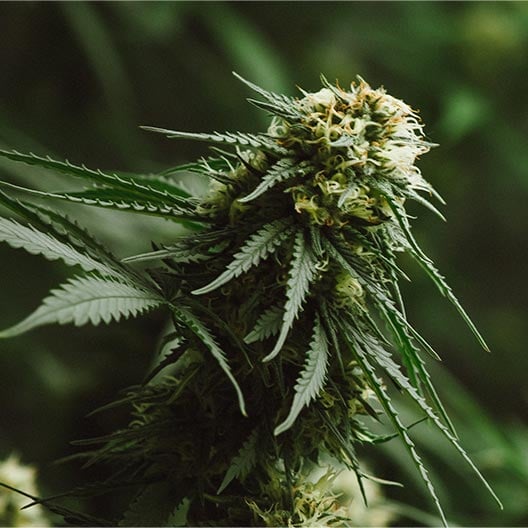
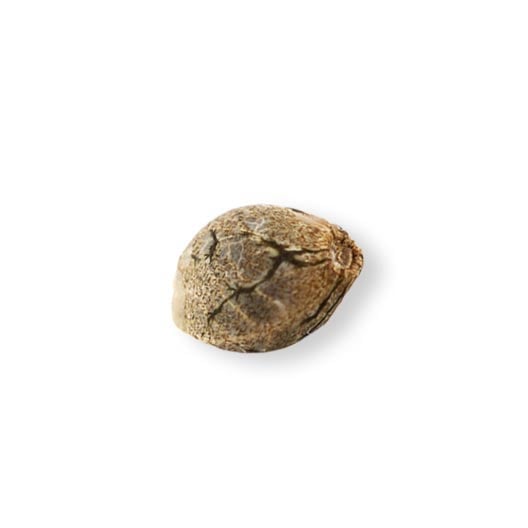
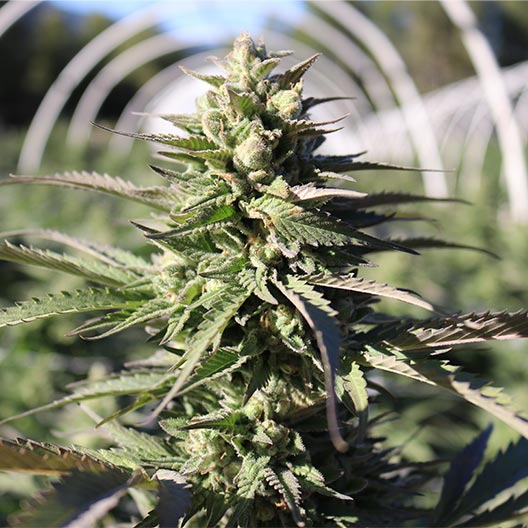
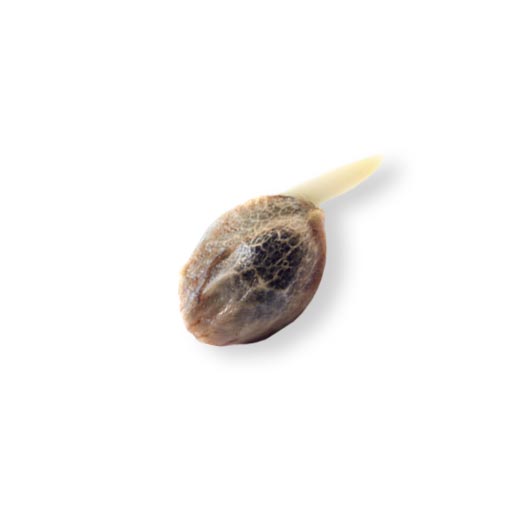
Look closely at a finished cannabis flower and you’ll see it’s covered in something like frost. Those are trichomes. Trichomes on weed aren’t decoration; almost every cannabinoid and terpene in your jar was made inside those glands. Learning to read them is the most useful skill a home grower can pick up, because the same plant harvested three weeks apart gives you two noticeably different results.
This guide covers what trichomes are, the three types you’ll find on a cannabis plant, how to read the clear-to-cloudy-to-amber color shift that tells you when to cut, how to inspect them properly, and what actually increases resin production versus what’s grower folklore.
What Are Trichomes on Weed?
Trichomes are glandular outgrowths on the surface of the cannabis plant. The name comes from the Greek tríchōma, meaning growth of hair, which is a fair description of what they look like under magnification: stalks topped with a bulbous head.
That head is the important part. It’s a small chemical factory where the plant assembles cannabinoids like THCA and CBDA, along with the terpenes responsible for a strain’s smell and flavor (Tahir et al., 2021).
This is why bud is worth more than trim. Across three chemovars in one study, cannabinoid concentration in flower tissue ran 15.77–20.37%, while leaf tissue sat at 1.10–2.10% (Jin et al., 2020). Same plant, same genetics. The difference is trichome density.
Worth a caveat, though: growers routinely treat visible frost as a potency reading, and the relationship is looser than that. Heavy trichome coverage is a good sign. It isn’t a lab result.
Trichomes didn’t evolve to get anyone high. Cannabinoids appear to function as a chemical defense, deterring insects that chew on the plant (Stack et al., 2023), and the sticky resin physically traps small pests. The psychoactivity is incidental to that job. We’ve spent a few thousand years selecting for it anyway.
The Three Types of Cannabis Trichomes
Not every trichome on your plant is doing the same work, and only one type is worth your attention at harvest.
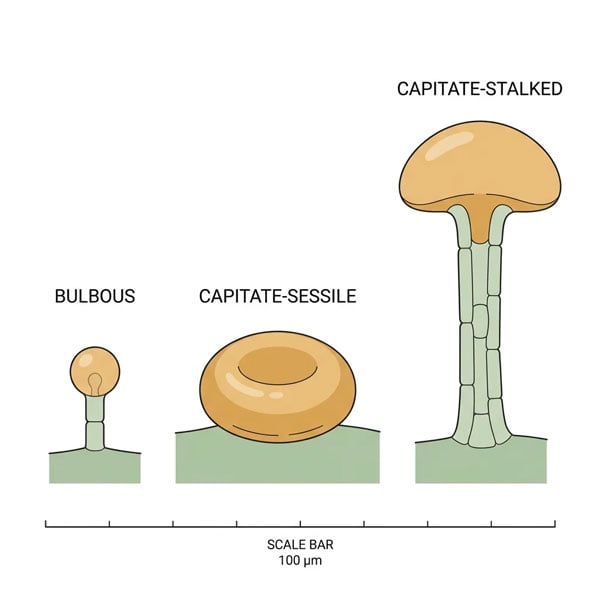
Bulbous Trichomes
The smallest. Their heads measure roughly 15–30 micrometers across, sitting on short pedicels of about 10–15 micrometers (Punja et al., 2023). A human hair is somewhere around 70 micrometers wide, so these are well below what your eye can resolve.
Bulbous trichomes appear across most of the plant’s surface. They produce the same class of compounds as the larger types, but there’s so little volume in each head that their contribution to your finished flower is minor.
Capitate-Sessile Trichomes
Structurally, the interesting one. Capitate-sessile trichomes have a head sitting directly on the plant surface with little or no stalk beneath it, and they’re far more abundant than bulbous trichomes.
They also don’t stay sessile. Research tracking trichome populations through flowering found sessile forms predominating early and stalked forms taking over as the plant matured (Punja et al., 2023), meaning many of the sessile trichomes on a three-week flower become the stalked trichomes you’re inspecting at week nine.
Capitate-Stalked Trichomes
These are the ones that matter. Capitate-stalked trichomes have glandular heads ranging from 40 to 110 micrometers in diameter, mounted on stalks that vary enormously in length, anywhere from 20 to 1,100 micrometers (Punja et al., 2023).
They’re the largest and most abundant glandular trichomes on flowering material and they hold the bulk of the plant’s cannabinoids and terpenes. At the upper end of that size range you can make out individual heads with the naked eye as a glistening texture on the calyx, though not clearly enough to judge their color. When a guide tells you to check your trichomes before harvest, these are what it means.
How Trichomes Develop Through Flower
Trichome production ramps up once the plant moves into flower and starts building buds in earnest. Cells in the gland head begin producing the precursors that become cannabinoids and terpenes, and the heads fill as flowering progresses.
You’ll usually see the first meaningful changes around three to four weeks into flowering: heads visibly enlarging, coverage spreading from the calyxes onto the surrounding sugar leaves. From there, both the shape of the glands and what’s inside them keeps shifting right through to the end of the cycle (Livingston et al., 2020).
One finding worth holding onto is that maturation timing varies significantly between genotypes, and that variation alone can drive differences in final cannabinoid levels (Punja et al., 2023). A strain-specific harvest window from a breeder is a starting point, not an instruction. Your phenotype, your environment, and your lights all shift it.
Autoflowers compress this. The same sequence happens on a shorter clock, so the window between “not ready” and “past it” is narrower and you’ll want to check more often once flowering slows.
Reading Trichome Color: Clear, Cloudy, and Amber
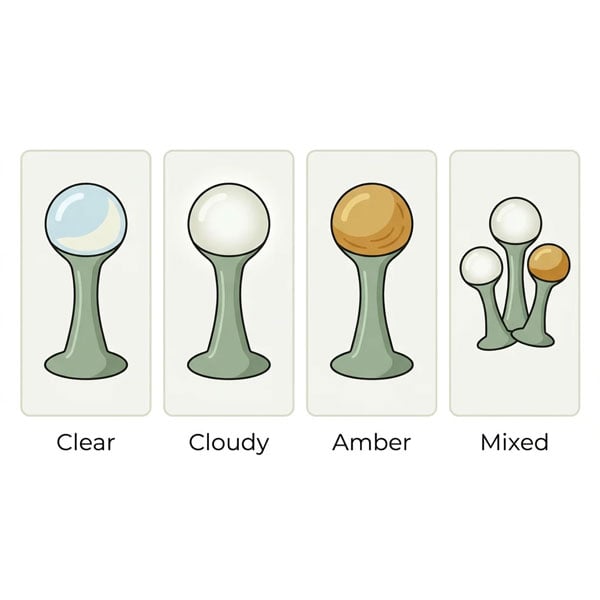
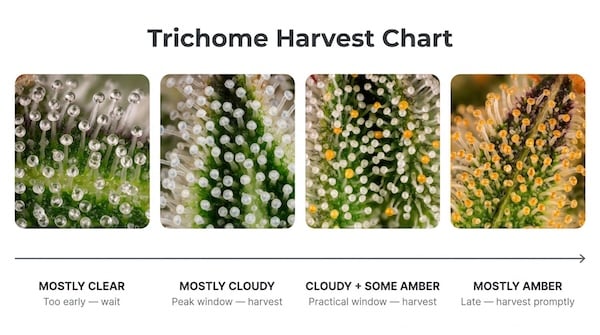
This is the part that changes your results. As trichome heads mature, the resin inside shifts from clear and translucent, to cloudy or milky white, and finally to amber (Punja et al., 2023). Growers use that progression as a ripeness gauge.
| Trichome appearance | What it means | Harvest guidance |
|---|---|---|
| Clear / translucent | Glands still filling | Too early. Cutting now costs you flower weight and cannabinoid accumulation |
| Cloudy / milky white | Mature, opaque resin heads | The main target for a THC-forward, balanced harvest |
| Amber / brown | Later-stage gland aging | THC degrades over time, some of it toward CBN. Amber does not automatically mean a sedating effect |
| Mostly cloudy with some amber | Mature flowers, some glands aging | The practical target most growers aim for |
Clear Trichomes
Clear heads are still under construction. The gland has formed but hasn’t finished filling. Harvest here and you get lighter, weaker flower, plus you’ve thrown away the weeks of resin accumulation still to come. Clear across the whole plant means wait.
Cloudy (Milky) Trichomes
When heads turn opaque and milky white, the gland has finished filling. For most growers chasing a bright, THC-forward result, a canopy that reads predominantly cloudy is the window.
It’s also the window if you’re growing for hash or rosin rather than flower. Intact, well-filled heads separate cleanly; aged, brittle ones don’t. Extractors generally cut earlier than flower growers for exactly that reason.
Amber Trichomes
Amber means the gland is aging. Cannabinoids degrade over time, with THC oxidizing toward CBN among other pathways, and the resin darkens as it happens.
Here’s where the usual advice deserves pushback. Amber is widely described as producing a heavier, more sedating effect, and that claim gets repeated far more confidently than the evidence supports. The color transition itself is well documented, but the browning is gland senescence, and it has not been shown to be CBN accumulation. Genotype influences maturation timing and cannabinoid accumulation somewhat independently (Punja et al., 2023). Treat amber as a signal that glands are aging, not as a dial that sets the effect.
How Much Amber Should You Wait For?
Growers throw around numbers: 10% amber, 20%, 30%. There’s no research establishing those thresholds, and a “20% amber” reading is an eyeball estimate across a plant with real variation from top cola to lower branch anyway.
What works is simpler. Aim for a canopy that reads mostly cloudy, then decide how far past that to go based on preference. If you liked how your last run finished, note where you cut and repeat it. Your own record from your own plants beats a number from a forum.
How to Actually Look at Your Trichomes
Most growers who harvest at the wrong time aren’t misreading the colors. They never looked properly.
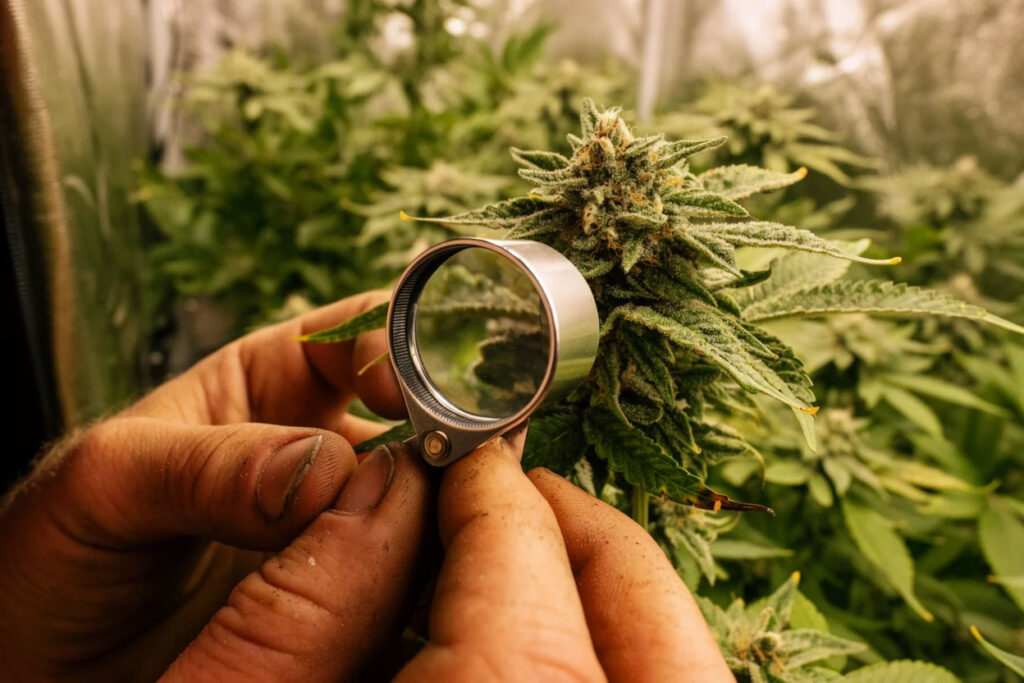
The naked eye isn’t enough. You can see that trichomes are present and get a rough sense of coverage. You cannot reliably tell clear from cloudy. Every year growers cut early because a plant looked frosty from three feet away.
A jeweler’s loupe is the cheap fix. Something in the 30x to 60x range costs very little and does the job. Past about 100x it gets hard to hold steady against a live plant.
A USB microscope is better. Plug it into a laptop or phone, get a magnified view on a screen, and you can save shots and compare them week to week. If you’re dialing in harvest timing across multiple runs, that’s worth the money. An image from last harvest is a far better reference than your memory of it.
A clip-on phone macro lens works too, with the advantage that you’re already carrying the phone.
Start checking around week six of flower, or once bud development visibly slows, then look every two or three days. The window from mostly-cloudy to noticeably-amber can close inside a week.
Where you look matters as much as what you look through:
- Check the calyxes, not the sugar leaves. Trichomes on leaves mature faster and will read amber while the flower is still cloudy. Judge on flower material.
- Sample several sites. Top colas get more light and ripen ahead of lower branches. Check top, middle and bottom before deciding.
- Use consistent lighting. Grow lights, especially heavy-red flowering spectrums, distort color badly. Take a small cutting into neutral white light, or shoot with the scope’s own LED.
- Check at the same point in the light cycle so you’re comparing like with like.
Trichomes or Mold? How to Tell the Difference
Newer growers regularly panic about mold that turns out to be resin and, more dangerously, miss real mold because they assume it’s frost. The two look nothing alike once you know what you’re looking for.
Trichomes are discrete structures: individual stalks with round heads, evenly distributed, reflective and glassy. Under any magnification you can pick out the individual glands.
Mold is a mat rather than a collection of structures. Powdery mildew shows as a flat, dusty white film sitting on leaf and flower surfaces, often in circular patches, and it wipes off. Botrytis, or bud rot, is worse and hides inside the flower, turning the interior gray-brown and mushy while the outside can look fine (Mahmoud et al., 2023).
Three quick checks. Trichomes are three-dimensional under magnification and mold is flat. Trichomes smell like the strain; mold smells musty, like wet cardboard. Trichomes are sticky and mold is dry and dusty.
If a dense cola feels light or soft when you squeeze it gently, open it up. Bud rot works from the inside out, and if you find it, remove the affected material and everything touching it rather than trying to trim around the edges.
How to Grow More Trichomes
Trichome density is set by genetics first and conditions second, but the gap between a well-run tent and a poorly-run one on the same seed is large.
Start With Genetics
You cannot grow a low-resin cultivar into a frosty one. Some strains simply produce fewer, smaller glands. If resin content is your priority, that decision is made at the point of purchase, and environmental tuning won’t recover it later.
Light Intensity and Spectrum
Light is the biggest environmental lever you have, and the ceiling is higher than most home growers assume. Testing canopy PPFD from 120 to 1,800 µmol/m²/s at ambient CO₂, dry inflorescence yield increased linearly right across that range, from 116 to 519 g/m², with no effect on cannabinoid potency (Rodriguez-Morrison et al., 2021a).
Read that carefully, because it cuts both ways. More light gives you more total resin by giving you more flower, not by making the flower frostier. The common 800–1,000 µmol target isn’t a biological ceiling; it’s where a typical home fixture and passive cooling top out. If you can add light without adding heat you can’t manage, the plant will use it.
Canopy management matters as much as raw output. Uneven canopies produce uneven resin. Keep the top level with low-stress training or selective pruning, set fixture height properly, measure PPFD at several points rather than just the center, and don’t leave lower bud sites in deep shade.
On UV-B, be skeptical. It’s frequently sold as a THC booster on the logic that plants produce more resin to shield themselves from UV. The mechanism is plausible, and an early study reported a modest THC increase in one chemotype. A controlled 2021 trial found otherwise: in one cultivar, inflorescence yield and both THC and CBD concentrations decreased as UV exposure rose, alongside reduced photosynthetic rates, leaf malformation, stigma browning and foliar necrosis. The authors concluded that UV exposure “did not lead to any commercially relevant benefits” (Rodriguez-Morrison et al., 2021b). Treat it as an experiment on a plant you can afford to lose.
Temperature, Humidity, and Airflow
Daytime temperatures of roughly 68–78°F (20–26°C) through flower keep the plant productive without cooking off terpenes.
Humidity involves a genuine trade-off that most guides skate over. A vapor pressure deficit around 1.0–1.4 kPa is efficient for transpiration, and at those temperatures that works out to roughly 55–65% RH. But dense late-flower colas are exactly what Botrytis colonizes from the inside (Mahmoud et al., 2023), so most growers deliberately run drier than optimal VPD in the final weeks, down toward 45–50%, trading a little transpiration efficiency for a lot of mold-risk reduction. That’s the right trade on a home grow. Just make the choice knowingly rather than chasing two incompatible numbers.
Airflow underneath the canopy matters more than airflow above it. Stagnant air inside a thick canopy is where problems start.
Nutrients, pH, and the Deficiencies That Cost You Resin
Feed for plant health rather than chasing a bottled bud booster. The deficiencies that show up most often in resin problems are magnesium, sulfur and calcium. Magnesium deficiency appears as yellowing between the veins of older leaves. Sulfur deficiency shows as general yellowing on newer growth. Calcium deficiency hits new growth first, causing distorted leaves, weak structure, and rust-colored or necrotic spots.
None of it gets absorbed if your pH is off. Target 6.0–6.8 in soil and 5.5–6.5 in coco or hydroponics. Drift much outside those bands and you lock out nutrients that are physically present in the root zone.
One more: excess nitrogen late in flower is a common cause of disappointing resin. Nitrogen drives leafy vegetative growth at exactly the point you want the plant putting energy into flower.
What Doesn’t Work
A fair amount of resin advice is folklore:
- Darkness before harvest. Giving plants 24 to 72 hours of complete dark before cutting has no evidence behind it for increased trichomes, cannabinoids or terpenes.
- Ice-water flushing and cold shock. Same category. Unproven.
- Flushing generally. A controlled trial comparing flushes at 0, 7, 10 and 14 days before harvest found no significant differences in yield, THC, terpenes, flavor, smoothness or ash color. The one measurable difference ran the other way: iron was at least 50 ppm higher in the flower flushed for 10 or 14 days (Wedryk et al., n.d.).
- Deliberate stress. Brief controlled stress can shift plant chemistry, but sustained stress reduces photosynthesis and yield. Resin accumulates gradually, and a struggling plant hasn’t got the energy budget for it.
Low-stress training and light defoliation do help, but they help as canopy management, getting more bud sites into good light and improving airflow. They aren’t stress treatments, and stripping too many leaves removes the machinery that powers flower development.
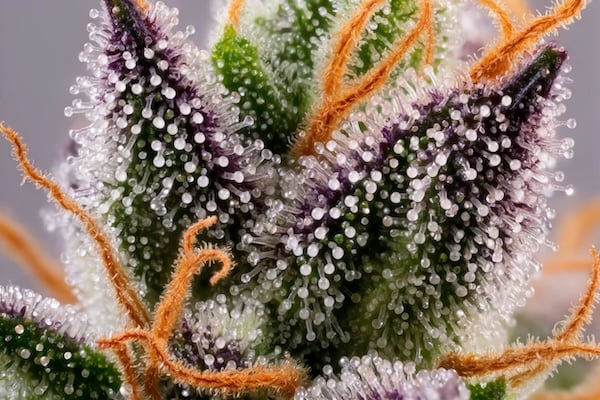
Image credit: Premium Cultivars
Protecting the Trichomes You Grew
Trichome heads are fragile. They’re damaged by physical contact, heat, light, oxygen and time.
Handle plants by the stem, not the flower. Dry slowly: somewhere near 60°F (16°C) and 60% RH is a reliable baseline. Fast, hot drying degrades terpenes and makes glands brittle. Trim gently with sharp shears rather than dragging blades through flower, and store finished flower cool, dark and in airtight glass.
CBN accumulation mostly happens here rather than on the plant, over weeks and months of storage. If you want to keep a batch bright, keep it cold and dark. For more on timing and technique, see our guide to harvesting marijuana.
High-Resin Strains Worth Growing
If frost is the priority, start with genetics known for it:
- White Widow — a Brazilian sativa crossed with a South Indian indica, and one of the most famous frosted cultivars ever released. Heavy trichome coverage and forgiving to grow, which makes it a strong first choice.
- Northern Lights — Afghani and Thai lineage by most accounts, though the genetics are genuinely murky. Resin-coated flowers, above-average resilience, compact and dependable for beginners.
- Original Glue — an indica-leaning hybrid from Chem’s Sister, Sour Dubb and Chocolate Diesel, finishing in roughly 55–65 days. The sticky, pungent profile made it a favorite for growers producing resin-rich material.
- Bruce Banner #3 — OG Kush crossed with Strawberry Diesel. Generous trichome coverage and vigorous growth, best suited to growers with room for a larger canopy.
- Godfather OG — bred from XXX OG and Alpha OG, producing dense, crystal-coated flower on a compact, manageable plant.
Browse the full range of feminized seeds at Pacific Seed Bank, all backed by our germination guarantee.
Conclusion
Trichomes are the point of the grow. They’re where the cannabinoids and terpenes are made, they’re the difference between flower and trim, and their color is the best practical signal you have for when to cut, as long as you read it as ripeness rather than as a potency score.
Get the basics right and you’ll be ahead of most home growers. Buy genetics that produce resin, give the plant as much light as you can cool, and inspect the calyxes under real magnification instead of guessing from across the tent. Skip the folklore, the darkness tricks and the ice-water flushes, and put that effort into a level canopy and a slow dry.
Then keep notes. Photograph your trichomes weekly through late flower, record where you cut, and compare it against how the cured flower turned out. After two or three runs you’ll have a harvest window calibrated to your plants, your room and your preference, which is worth more than any general guideline.
Ready to start a resin-focused grow? Browse our feminized cannabis seeds and pick genetics built for it.
Frequently Asked Questions
When should I start checking my trichomes?
Around week six of flower, or whenever bud growth visibly slows and pistils start receding. Before that the glands are still filling and there’s nothing to decide. Once you’re in the window, check every two or three days. On autoflowers, check more often, since the compressed cycle narrows the gap between not-ready and past-it.
Should I harvest earlier if I'm making hash or rosin?
Generally yes. Extraction depends on gland heads separating cleanly from the plant, and well-filled cloudy heads do that better than aged, brittle amber ones. Most extractors cut at peak cloudy, earlier than they would for flower. If you’re doing both from one plant, prioritize whichever product you care about more, because there’s no timing that’s optimal for both.
Can I harvest the top colas first and leave the lower branches?
Yes, and it’s often the better call. Top colas get more light and ripen days to a week ahead of the bottom. Taking them first lets light reach the lower sites, which finish them more evenly. The trade-off is a longer, messier harvest and two separate dries to manage.
Does more amber mean a more sedating high?
It’s the standard claim, and it’s stated with more confidence than the evidence supports. The clear-to-cloudy-to-amber progression is well documented, but the browning is gland aging rather than demonstrated CBN accumulation, and genotype affects both maturation timing and cannabinoid content. Amber reliably tells you glands are aging. Beyond that, trust your own results over a rule of thumb.
Is the white stuff on my buds trichomes or mold?
Trichomes are individual stalked structures, evenly spread, glassy and sticky, and they smell like the strain. Mold is a flat mat: powdery mildew looks dusty and wipes off, while bud rot hides inside dense flowers and turns the core gray-brown and soft. Squeeze a dense cola gently. If it feels light or spongy, open it. If you find rot, remove the affected material and anything touching it rather than trimming around it.
Why aren't my buds frosty?
Usually genetics or light. Some cultivars simply don’t produce heavy resin, and low canopy PPFD limits how much flower the plant can build in the first place. After those two: excessive heat in late flower, too much nitrogen going into bloom, cutting before the glands finished filling, and rough handling during trim and dry that knocks the heads off.
Pacific Seed Bank sells cannabis seeds as adult souvenirs and collectibles. Germination may be illegal in your jurisdiction. Check your state and local laws before germinating, and grow only within your legal plant limits.
References
Jin, D., Dai, K., Xie, Z., & Chen, J. (2020). Secondary metabolites profiled in cannabis inflorescences, leaves, stem barks, and roots for medicinal purposes. Scientific Reports, 10, 3309. https://doi.org/10.1038/s41598-020-60172-6
Livingston, S. J., et al. (2020). Cannabis glandular trichomes alter morphology and metabolite content during flower maturation. The Plant Journal, 101(1), 37–56. https://doi.org/10.1111/tpj.14516
Mahmoud, M. E., et al. (2023). Understanding bud rot development, caused by Botrytis cinerea, on cannabis (Cannabis sativa L.) plants grown under greenhouse conditions. Botany. https://doi.org/10.1139/cjb-2022-0139
Punja, Z. K., Sutton, D. B., & Kim, T. (2023). Glandular trichome development, morphology, and maturation are influenced by plant age and genotype in high THC-containing cannabis (Cannabis sativa L.) inflorescences. Journal of Cannabis Research, 5, 12. https://doi.org/10.1186/s42238-023-00178-9
Rodriguez-Morrison, V., Llewellyn, D., & Zheng, Y. (2021a). Cannabis yield, potency, and leaf photosynthesis respond differently to increasing light levels in an indoor environment. Frontiers in Plant Science, 12, 646020. https://doi.org/10.3389/fpls.2021.646020
Rodriguez-Morrison, V., Llewellyn, D., & Zheng, Y. (2021b). Cannabis inflorescence yield and cannabinoid concentration are not increased with exposure to short-wavelength ultraviolet-B radiation. Frontiers in Plant Science, 12, 725078. https://doi.org/10.3389/fpls.2021.725078
Stack, G. M., Snyder, S. I., Toth, J. A., Quade, M. A., Crawford, J. L., McKay, J. K., Jackowetz, J. N., Wang, P., Philippe, G., Hansen, J. L., Moore, V. M., Rose, J. K. C., & Smart, L. B. (2023). Cannabinoids function in defense against chewing herbivores in Cannabis sativa L. Horticulture Research, 10(11), uhad207. https://doi.org/10.1093/hr/uhad207
Tahir, M. N., Shahbazi, F., Rondeau-Gagné, S., & Trant, J. F. (2021). The biosynthesis of the cannabinoids. Journal of Cannabis Research, 3, 7. https://doi.org/10.1186/s42238-021-00062-4
Wedryk, S., Wall, T., & Bennett, R. (n.d.). Flushing trial: Impact of different flushing times on quality and taste in Cannabis sativa L. Rx Green Technologies. https://www.rxgreentechnologies.com/wp-content/uploads/2019/11/FlushingTimes_TrialReport.pdf