Low stress training (LST) is one of the most effective, low-risk ways to maximize your harvest. This cannabis cultivation technique involves gently bending and securing your plants’ branches to reshape the canopy, expose more bud sites to direct light, and ultimately produce greater yields.
Many growers use LST because it tends to be a gentler and less time-consuming approach in comparison to other training techniques. For instance, ScrOG can be highly effective in establishing a broad, even canopy, but also requires greater up-front effort, while topping, a high stress training (HST) technique, involves pruning your plants, which produces added stress.
LST is different because it avoids shocking your plants and is fairly simple to perform, making it an excellent choice for beginner growers or intermediate cultivators who simply prefer a less aggressive approach. LST also works well with both feminized photoperiod strains and autoflower plants alike. In fact, it can be an especially suitable choice for auto strains, as they tend to have a shorter life cycle overall, which means less time to recover from more stressful techniques like topping.
In this guide, we’ll cover what LST does exactly, when to begin the process, and the tools you’ll require. We’ll also provide a step-by-step overview of how to perform LST, which can help you navigate the process with ease, even if you’ve never tried it before.
What Is Low Stress Training (LST)?
To understand why low stress training weed is so effective, we’ll first look at how a cannabis plant grows naturally. Left to its own devices, it follows a growth pattern called “apical dominance,” meaning it directs the majority of its energy into the tallest central stem (the apical meristem). (Ijoma et al., 2025)
LST breaks this pattern. When a plant’s main stems are bent downward and to the side, it will redistribute its growth hormones to the lower nodes, devoting its energy outward, rather than upwards towards a single cola. The result is a flatter, more even canopy and a multitude of uniform bud sites. Some growers have reported that LST increases their yields by up to 25%. (North, 2023).
More specifically, LST benefits include:
- Superior light penetration to the entire plant structure, resulting in robust yields
- Improved airflow through the canopy, which reduces the likelihood of issues like mold and bud rot
- Excellent height control for growers, especially those working indoors or with smaller tents.
LST vs. HST: The Key Differences
Training Type: Low Stress Training (LST)
Method: Bending, tying, LST clips
Plant Damage Recovery Time: None (non-destructive)
Training Type: High Stress Training (HST)
Method: Topping, FIMing, super cropping, cutting, or snapping tissue
Plant Damage Recovery Time: 3 to 7+ days
When to Start Low Stress Training
Timing is everything when learning when to start LST. Typically, it’s best to begin during the early vegetative stage, or about ~2–3 weeks into the entire growing process. At this point, your young plant will have about 3–5 nodes and a mainstem that is still green, soft, and highly flexible. If you wait too long, however, the lower parts of the stem will become woody, stiff, and fibrous. Attempting to bend a woody stem will likely result in a clean snap, which can only be resolved by techniques like super cropping or topping. LST should typically stop 3-4 weeks into the flowering stage.
Photoperiod vs. Autoflower Timing
For autoflowering plants, it’s helpful to start earlier and take a gentler approach. Autos flower on their own and run on a fixed clock, so begin during the first 2-3 weeks or when 3-4 nodes have appeared, making sure to avoid any high-stress techniques.
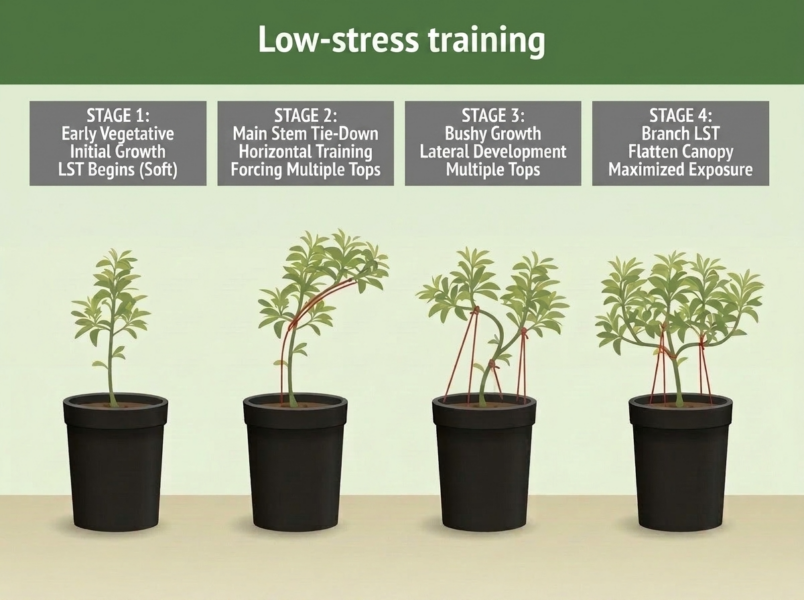 Image credit: Cannabis Seeds
Low Stress Training Step by Step
Whether you’re new to cannabis cultivation or just want a refresher, it can be helpful to look over the LST process step by step. Below, we explain in an easy-to-follow way how growers of all skill levels can perform LST with ease.
Step 1: Gather Your Tools
To start off, make sure to have low stress training wire, LST clips, and potentially wooden stakes or a trellis on hand. Once you have these items, you’re ready to prep your container. If you are using plastic pots, it can be helpful to drill a few holes around the rim; these will provide points where you can anchor your low stress training wire down. If you’ve opted for fabric pots, LST clips will work perfectly.
Step 2: Bend the Main Stem
Before you bend the top of the plant, loop a soft tie around the base of the main stem and pull it gently in the opposite direction of your planned bend first. This counter-tension protects the delicate root system from being damaged, dislodged, or stressed. Once that’s done, you’re ready to go! Gently take the tallest tip of the plant and bend it down toward the edge of the pot until it is level with, or slightly below, the lower side branches.
Step 3: Secure Your Plant
Loop a piece of soft garden wire around the bent stem and anchor it to the rim of your pot. Keep the tension firm but gentle. Depending on the type of pot you’re using, you can use an LST clip to anchor the branch without using any ties.
Step 4: Spread the Side Branches
As the lower branches begin to shoot upward toward the light, pull them outward and away from the center of the plant. They should be angled away similar to spokes on a bicycle wheel. Tie these branches down to keep the center of your plant open and airy.
Step 5: Maintain and Retrain
Check your plants every 2 to 3 days. Cannabis grows incredibly fast, so the branches you’ve already bent may start to orient themselves upward within just 24 hours. Adjust your ties and add new ones as the canopy expands.
Step 6: How to Handle Accidents
If you bend a branch too hard and hear a snap, don’t panic. Instead, grab some duct tape or painter’s tape and wrap your tape around the broken area like a bandage. Cannabis is a resilient plant in general, and with this added support, while there may be a scar left behind, your plant should heal relatively quickly.
This low-stress training diagram illustrates LST weed before, during, and after the process while highlighting this technique’s benefits.
Tools You Need for LST
- Soft Plant Ties or Garden Wire: It’s important to use rubber-coated or foam-coated wire. Avoid bare, thin wire or fishing line, as they will slice right through the plant’s skin under tension.
- LST Clips: These plastic, 90-degree bending clips are highly popular for beginners. They clip directly onto branches to force a bend without needing anchor points on your pots.
- Bamboo Stakes & Trellis Netting: Ideal for supporting branches as they get heavier later in life.
- Duct Tape & Scissors: Keep these nearby for emergency patch-ups if a branch splits.
A standard pack of forty or fifty 90-degree LST clips often runs somewhere between $8 and $15. More advanced clips are often curved, adjustable, or 3D-printed. These typically come in packs of 15-30, which can cost between $10 and $25.
When selecting your equipment, it’s good to focus on LST clips made from UV-resistant materials like polypropylene or Polyethylene Terephthalate Glycol (PETG). In comparison to plastic clips, they are less likely to become brittle under any intense grow lights. It can also be helpful to use LST clips that have smooth, rounded edges and deep grooves; they are better-equipped to stay in place yet won’t slice into your plants’ delicate outer tissue.
 Image credit: Francis Costelloe
Low Stress Training Autoflowers
Many growers may wonder if you can use LST on autoflowering strains. The answer is yes! In fact, low-stress training autoflowers is one of the most effective ways to maximize their yield potential. Below, we’ll cover some good pointers on LST autoflower techniques and explain why this method is especially beneficial for autos.
Because autoflowers transition to flower automatically within a stricter timeframe (usually 3 to 4 weeks from germination), high-stress techniques like topping can stunt their growth and reduce their yields. LST allows you to open up the canopy without stalling growth, saving precious time.
Every auto strain will vary in terms of its vigor and strength, so your best bet is to take a gentler, slower approach. Autoflower low stress training isn’t dramatically different from photoperiod training; it’s important to make small adjustments daily rather than trying to force a massive bend all at once. It will also be helpful to keep timing in mind. Because these strains grow more quickly in general, the LST process will also be somewhat shorter. In general, aim to stop low stress training autoflowers when they are about 4-5 weeks into the growing cycle, or when pistils appear, making sure to stop by week 6 to give the buds time to put on additional weight. At this point, you can leave your LST ties in place and enjoy watching your plants continue to flourish!
LST vs. Other Plant Training Methods
You may be wondering how LST stacks up against other popular training methods. We’ve outlined some of the unique benefits of each approach below. While no single approach is inherently better, each of the following techniques can be an especially good fit, depending on your goals and experience level.
Topping vs. Low Stress Training
Topping involves cutting off the main stem to create two colas. Like LST, it can help improve light distribution across more bud sites and discourage vertical growth. Essentially, it’s a more dramatic approach to breaking apical dominance and encouraging a more manageable plant shape.
This technique involves wounding your plants, and accordingly, does require some recovery time. However, it encourages an especially broad and even canopy, especially when combined with LST.
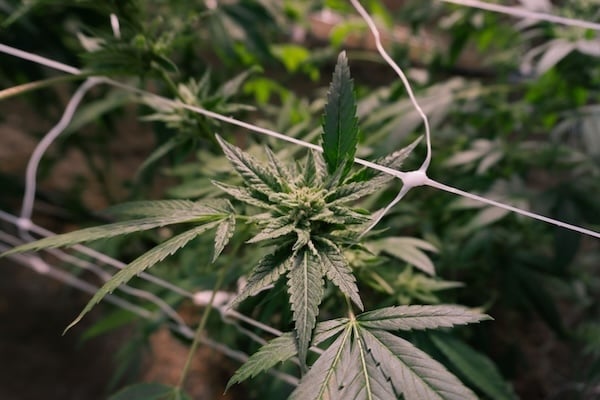 Image credit: Haley Bee
LST vs. ScrOG
The ScrOG (Screen of Green) training technique involves placing a horizontal net over your plants, and gently weaving the branches throughout this net. Essentially, it’s the same concept as LST—but at scale. Because the screen holds branches in place, it helps maintain a flat canopy and maximizes light exposure in a controlled way. This technique can be especially useful in indoor setups where canopy height and space efficiency tend to matter most.
LST vs. Super Cropping / HST
Super cropping intentionally crushes the inner stem to create a more dramatic bend, sooner. Super cropping can be useful for shaping more vigorous plants, but like topping, it’s a high-stress training technique, meaning your plants will need time to recover. Conversely, LST avoids damaging your plants entirely.
Ultimately, the right technique depends on your specific setup, experience level, and schedule. While LST is excellent for beginners or those cultivating auto strains, the methods discussed above can produce more dramatic results. As a grower’s skills develop, they may choose to combine LST with another training technique above. A two-pronged approach will require some extra effort and skill, but if executed right, can provide an especially fine-tuned, yield-boosting growing strategy.
Still, LST remains the gentler, simpler, and lower-risk option, making it a good choice for beginner growers or intermediate cultivators seeking less severe training options.
A Closing Note
LST is one of the safest and most beginner-friendly training methods you can use. It helps you build a flatter canopy, improve light exposure, and increase yield potential without the recovery time associated with more aggressive techniques. If you’re getting ready for your next grow or are just starting out, this method helps build confidence and encourages greater yields all at once.
We also have other helpful guides that cover topics like beginner growing tips, how to water your cannabis plants, and the key differences between auto and photoperiod strains. If you haven’t decided which strain you’d like to grow, our expansive seed library is a good place to start exploring. It’s large enough to meet a variety of unique preferences and includes many beginner-friendly choices. We invite you to try LST on your next grow and see how much of a difference this training technique can make.
References
Ijoma, G. N., Mannie, T., Nurmahomed, W., Adriaanse, P., & Tekere, M. (2025). The curious origins of a high-stress training technique, mainlining: Its molecular, biochemical, and agronomic perspectives for the cultivation of Cannabis sativa. Journal of Cannabis Research, 7(1), Article 339. https://doi.org/10.1186/s42238-025-00339-y
North, S. (2023, January 15). Low-stress training (LST) cannabis step-by-step. MSNL Seeds. https://www.msnlseeds.com/blog/low-stress-training-cannabis/
FAQs
When should I start low-stress training?
Begin low-stress training during the early vegetative stage or once your plants have 3-4 nodes (typically 2 to 3 weeks from seed). At this stage, the young stems are green and highly flexible, allowing you to bend them safely without snapping. For LST autoflower plants, start slightly earlier (around the 3rd node) as they grow more quickly.
Does low stress training increase yields?
Yes, LST training is highly effective at boosting yields. By physically bending down the main stem, you break the plant’s apical dominance and redistribute growth hormones (auxins) evenly to lower branches. This creates a flat, even canopy where multiple bud sites receive direct, uniform light intensity instead of being blocked by the upper branches. While your total yields will also be affected by lighting, genetics, and the environment, this technique can play a vital role in ensuring a generous harvest.
Can you use LST with autoflowers?
Absolutely—low-stress training autoflowers is highly recommended over high-stress methods. Because autoflower plants are on a strict internal clock, they do not have the time to recover from stressful techniques like topping. Applying gentle, continuous LST starting in early vegetative growth allows you to safely open up the canopy and maximize bud development without stunting your plants.
What's the difference between LST and topping?
The primary difference involves physical damage and recovery time. LST is a non-destructive method that involves gently bending stems and fastening them down, with virtually no downtime. Topping is a high-stress training (HST) method where you physically cut off the growing tip of the main stem, prompting the plant to split into two main shoots. That said, intermediate or expert growers sometimes combine these two techniques for maximum canopy control.
Is it too late to start LST during flowering?
Yes, it is generally too late to start major branch bending once flowering is underway. LST should be completed by the early flowering stage, as this allows your plant to focus on bud production.
What can I use to tie down branches?
Always use thick, soft, or rubber-coated materials like low stress training wire, soft plant ties, silicone-coated garden wire, LST clips, or even soft pipe cleaners. Avoid thin household items like fishing line, sewing thread, or bare wire. Under the natural tension of a growing plant, thin materials will act like saw blades and slice directly into the stem’s tissue.